2. Security
Note

Name:Note
Note: 1. The company shall not be liable for problems caused by damaging, replacing, or modifying AMR or its accessories in any way. 2. The company shall not be liable for any damage to AMR, accessories, or any other equipment caused by programming errors or malfunctions.
Note
Before starting and running AMR, please read the contents of this section.
2.1. General Safety Precautions
This chapter contains general safety precautions
Note

Name:Robot Tipping Precautions
Note: 1. If the load is not placed or secured correctly, it may cause the load to fall or the robot to tip over. 2. Ensure that the load is placed according to specifications and secured correctly. Please refer to the payload specifications.
Note
Name:Machine Injury Precautions
Note: 1. The high-speed rotating parts of the vehicle body, such as universal wheels and drive wheels, may cause personal injury. 2. Do not rely excessively on the vehicle’s autonomous avoidance function; please take the initiative to avoid the vehicle.
Note

Name:Operating Precautions
Note: 1. The robot cannot observe descending stairs and holes in the floor. 2. Please mark the stairs and holes as prohibited areas on the map. 3. Please update the map promptly.
Note
Name: Battery Replacement Precautions
Note:1.When replacing the battery,be careful not to pinch your hand in the battery compartment door.2.After replacing the battery,please fully close and lock the battery compartment door。Prevent the battery from sliding out of the vehicle body during operation。
2.2. Safety Instructions
2.2.1. Personnel Qualification Requirements
AMR Only qualified safety personnel are permitted to install, commission, operate, and maintain. Mechanical Installation and Commissioning
Personnel performing mechanical installation and commissioning should possess professional knowledge and experience in the relevant field, have sufficient experience, and be able to assess whether the machine is in a safe operating state after protective equipment is used.
Electrical installation and commissioning Personnel who carry out electrical installation and commissioning shall have professional knowledge and experience in the relevant field, be sufficiently experienced, and be able to assess whether the machine is in safe operating condition after protective devices are used。 Operation and maintenance Personnel who carry out operation and maintenance shall have professional knowledge and experience in the relevant field, be familiar with the application of protective devices on the machine, and be instructed by the machine user。
2.2.2. Runtime Environment Security
The ground is flat, free of grooves, breakage, hollows, oil stains, adhesive and other contaminants.
The floor is free of foreign objects such as screws, rags, gloves, thread ends, and cables that can easily get caught in and entangle the wheels.
Do not operate in overly open areas(larger than the laser sensing distance),such as long corridors。
A fully loaded, low-speed robot can only cross steps no higher than 5mm.
When passing through a narrow passage, the outermost side of the robot must maintain a 10mm clearance from the passage.
Road sections in the operation area shall be protected or marked with warning signs to remind other personnel that robots are entering and exiting.
2.3. Security Message Type
This document contains the following security message types.
Note
Name:Warning
Note: Indicates a potentially hazardous situation that may result in death or serious injury. Appropriate precautions should be taken to avoid damage or injury.
Note
Name:Caution
Note: Indicates a potentially hazardous situation that may result in minor or moderate personal injury. Reminds to avoid unsafe practices. Appropriate precautions should be taken to avoid damage or injury.
Note
Name:Note
Note:Indicates important information, including conditions that may result in equipment or property damage.
Run Check
The operator should check the condition of the robot before activation to ensure safe use. Checks include:
Are the wheel fasteners tightened?
Whether the power system is normal.
Is the emergency stop function normal?
Is the load handling device damaged (e.g., bent, cracked, or worn)?
Whether the warning devices are normal.
Whether the ambient light is normal.
HMI display screen(optional,can be replaced by a laptop)is normal or not。
Whether the function of the laser sensor is normal.
Is the battery level normal?
Is the charging function normal?
Running on a Slope
Operation is only permitted on slopes that meet the performance parameters,please refer to 3.11 Technical Parameters Passability。
The upper and lower ends of the ramp should be flat to prevent the load or robot from contacting the ground.
No U-turns, diagonal operation, or parking on the ramp.
The tractor should not apply emergency braking when towing an unbraked trailer downhill.
Running in an elevator or lift
Ensure the elevator or lift can withstand the full weight including the robot and its load.
Ensure that no part of the robot comes into contact with the walls of the elevator or lift car.
Ensure the robot does not move unexpectedly.
Ensure that the elevator complies with GB7588-2003 standards.
2.3.1. Load Safety
AMR and its load must not exceed the allowable range of the road surface.
The goods carried must have reliable securing measures.
The goods being transported must be placed within the load center and have certain anti-slip measures. Please refer to 7. payload specifications.
The weight of the cargo carried by the upper structure must be evenly distributed and must not be eccentrically loaded.
2.3.2. Parking Safety
When the robot stops running, it should be shut down and the power should be cut off.
Do not park on the slope.
Do not park next to heat sources or fire sources.
Do not stop or park in open pits, underground passages, elevator shafts, or other similar areas.
Do not park in fire access routes, stairway entrances, or areas that obstruct access to firefighting equipment.
In special circumstances, safety measures should be taken for the robot, such as using wedges.
2.3.3. Safe avoidance range
Warning
The robot’s turning diameter is 990mm,please stay clear。
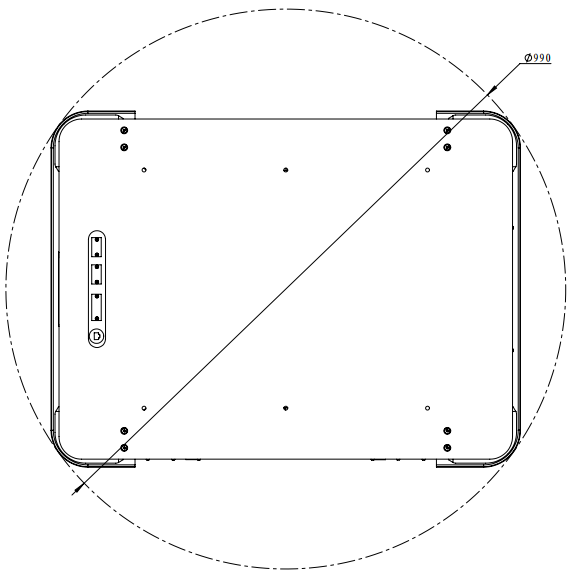
Chart 2-1 Safe Avoidance Range
2.4. Electrical Safety
2.4.1. Battery Safety
To avoid damage or personal injury caused by battery pack abuse, please carefully read the following safety guidelines:
Note
Name:Battery Usage Precautions
Note: 1. Lithium batteries are high-energy substances and must be used under certain technical conditions. If used beyond limits, the buyer must notify the seller in writing , and only after confirmation by the seller may such use proceed; otherwise, the consequences arising therefrom shall be borne by the party at fault. 2. Please use the original charger. Mixing chargers of other brands is prohibited; otherwise, irreversible damage may be caused to the battery.
The battery pack poses risks such as fire and explosion. Do not disassemble, crush, incinerate, heat, or throw the battery pack into fire.
For battery packs that are in a scrapped state, they should be disposed of promptly in accordance with local recycling or waste regulations.
Do not immerse the battery pack in water or get it wet.
Do not let the positive and negative terminals of the battery pack contact the metal case at the same time.
Do not short-circuit, overcharge, or over-discharge the battery pack.
Do not use or store the battery pack near heat sources(such as fire or heaters)。
Do not reverse the positive and negative terminals of the battery pack.
Do not use nails or other sharp objects to puncture the battery pack casing. Do not hammer or step on the battery pack.
Do not disassemble or modify the battery pack in any way without authorization.
Do not strike, throw, or subject the battery pack to mechanical vibration or natural dropping.
Do not mix battery packs of different types and brands.
If the battery pack emits an odor, heats up, deforms, discolors, or exhibits any other abnormal phenomenon, do not use it, and remove the battery pack from the use environment.
If the battery pack catches fire, use dry powder, foam fire extinguishers, sand, etc. to extinguish it and move the battery pack away from the operating environment.
2.4.2. Charging Safety
Note
Please note the automatic charging interface at the robot’s rear o part.
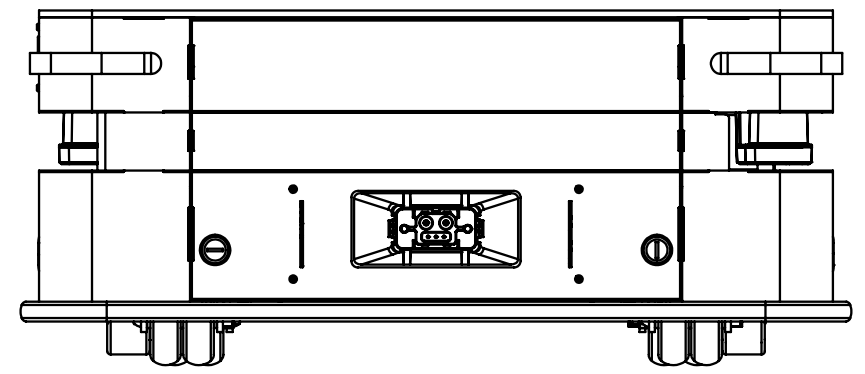
Figure 2-2 Automatic Charging Port
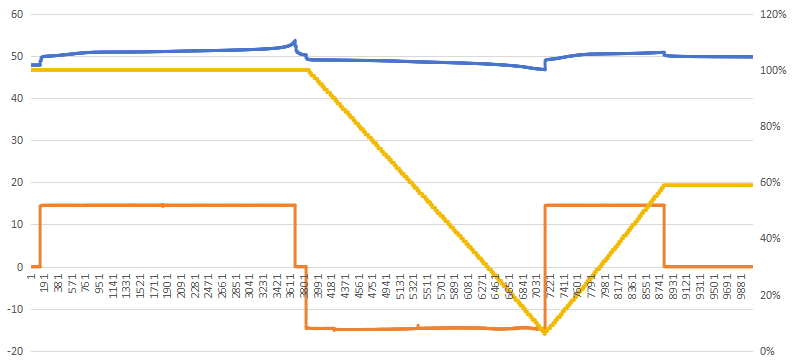
Chart 2-3 discharge-charge curve
2.4.3. Emergency Stop Safety
AMR设有两个急停按钮,呈对角分布。
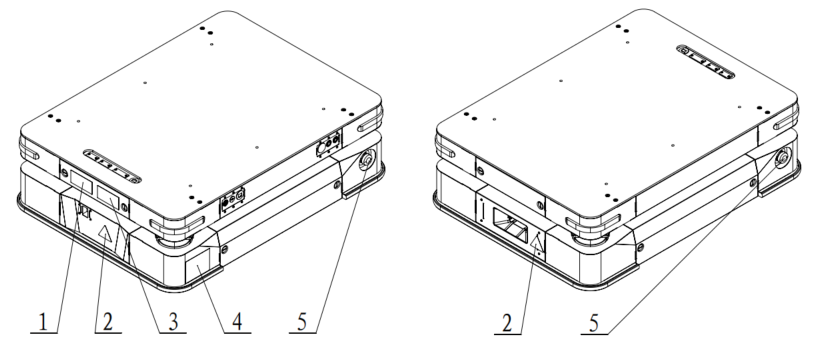
5- emergency stop button
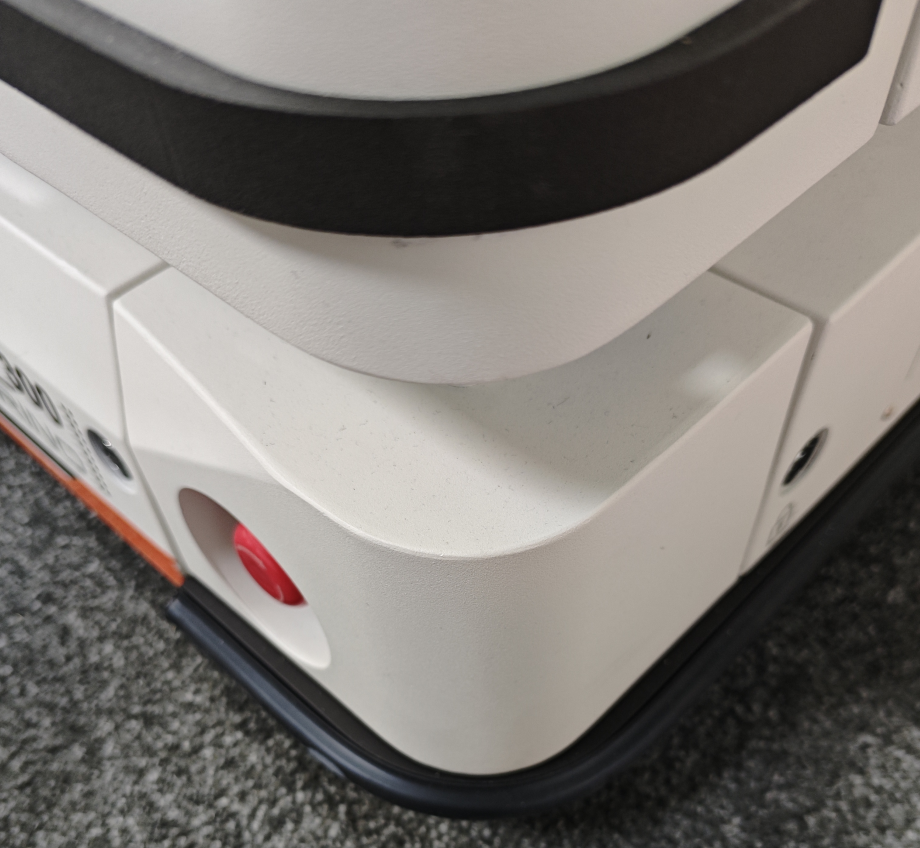
Diagram 2-4-2 Position of the Emergency Stop Button
If any abnormality is found,such as AMR out of control、collision risk、or personnel safety threat,immediately press the emergency stop button。After pressing the emergency stop button,notify relevant personnel,such as technicians、supervisors。Technicians troubleshoot the fault,and after resolving the problem,follow the reset procedure,rotate the emergency stop button clockwise to unlock it,then press the start button again to start AMR。Do not press it unless in an emergency,otherwise it will affect the production process and cause equipment failure。
The specific emergency stop behavior is as follows:
The emergency stop button is for emergency use only and must not be used to stop robot operation.
After the emergency stop button is pressed, the robot immediately stops all motion.
Only after the fault cause has been determined and the fault has been eliminated may the emergency stop be pulled up.
Note
Name:Robot Emergency Stop Precautions
Note: When using the company’s dispatch system, it is strictly prohibited to push the robot after pressing the emergency stop, otherwise it will cause robot task errors.
2.5. Risk Assessment
Risk assessment is one of the important steps for integrators to achieve safe installation. Usually, on-site commissioning personnel are responsible for risk assessment.
Risk assessment not only involves AMR chassis, but also should consider upper-level mechanism, peripheral modules, path planning, working environment, etc.
It is recommended to use the guidelines in ISO 12100, ISO 3691-4, ANSI B56.5 or other relevant standards for risk assessment. Including but not limited to:
During the installation, development, and use of AMR, perform teaching.
AMRThe device works normally.
In ISO 3691-4 Clause 4, list the significant hazards, hazardous situations and events requiring attention; risk assessment items shall be listed in the technical agreement.
2.6. Residual risk
The following lists potential major hazards,please operate with cautionAMR。
AMR can set a reverse route, but if there is no sensor at the rear, entering the AMR running route while reversing may result in a collision risk.
The user may accidentally come into contact with the moving parts of AMR, posing risks of hand pinching, foot crushing, and impact.
Risk of impact, jamming, and falling during load transportation.
2.7. Environmental Safety
2.7.1. noise
AMR noise ≤75 dB(A),complies with EN12053 standard。
2.7.2. Scrap Disposal
AMRcontains the following materials that affect environmental factors:
plastic
Battery
Disposal requirements:AMR The user and the final scrap processor,shall be responsible for disposal in accordance with《the Law of the People’s Republic of China on the Prevention and Control of Environmental Pollution by Solid Waste》。
2.8. Manipulator Installation Height Requirements
Formulated in accordance with mechanical safety standard IEC 60204-1。Installation height:The final height of the equipment’s operating interface(such as the keyboard surface of a laptop)from the ground,shall exceed 0.6 meters (600 mm)。
2.9. Load Transfer Safety Regulations
Basis: Formulated according to ISO 3691-4. During manual load handling or transfer, the vehicle must be in a power-off or emergency stop activated state to prevent accidental startup and ensure personnel safety.